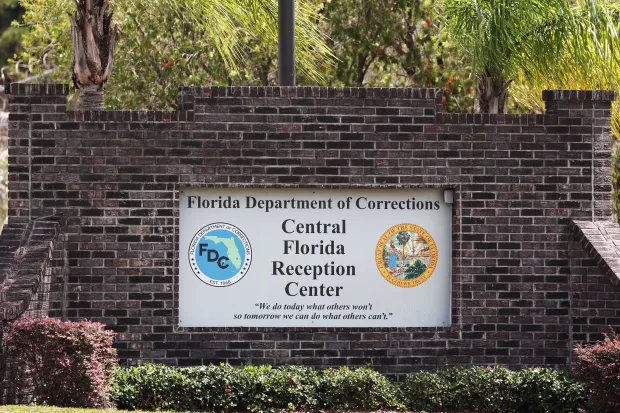

Central Florida Reception Center (CFRC) is a Florida Department of Corrections (FDC) facility at 7000 H C Kelley Rd in Orlando, Orange County, and one of the state's primary reception centers — the intake hub where newly sentenced men enter the FDC system before being classified and assigned to a longer-term institution. That intake function makes CFRC different from a typical state prison in some important ways for families to understand, from how long someone is likely to stay there to what "finding" someone at CFRC actually means. This guide explains how the reception process works and what to expect if a loved one has recently been sentenced and sent here.
History of Central Florida Reception Center
The facility opened in 1988, originally under the name Orange Correctional Institution, before being redesignated Central Florida Reception Center as its role in the department's statewide intake system was formalized. In December 2019, FDC partnered with the University of Central Florida on an instructor-led art program at CFRC's South Unit; the collaboration brought in photographers Chandra McCormick and Keith Calhoun to document participants for an exhibition titled "Illuminating the Darkness: Our Carceral Landscape," a project that used the arts to put a human face on incarceration.
What a Reception Center Actually Does
Unlike a standard FDC institution, CFRC's core job is not to house people for the duration of a sentence. When someone is convicted and sentenced to Florida state prison, they don't go directly to their eventual long-term facility — they first pass through a reception center like CFRC, where the department runs medical screening, mental-health evaluation, security classification, and educational/vocational assessment to determine which institution and custody level is the right fit going forward. Only after that classification process is complete does FDC transfer the person to the facility where they'll actually serve the bulk of their sentence. FDC does not publish a fixed length of stay for this process, and it can vary based on caseload and the complexity of an individual's classification needs, so if a loved one is currently at CFRC, it's worth checking back periodically rather than assuming their location is fixed.
This also means CFRC's population is, by design, more transient than a typical institution's — people are constantly arriving fresh from county jail and departing for their permanent assignment, which is part of why the facility's population count can run close to or even above its rated capacity at any given snapshot in time.
Who Is Held at Central Florida Reception Center
CFRC is a male-only facility housing inmates across minimum, medium, and close custody as they move through intake. The Main Unit is rated for approximately 1,659 beds; one state survey snapshot from August 2023 recorded 1,708 inmates present, modestly above rated capacity, which is consistent with a facility whose population fluctuates with intake volume. Two administratively separate FDC institutions share the same general compound — an East Unit (roughly 1,407 beds) and a smaller South Unit (roughly 150 beds) — each with its own FDC facility listing, so if you're searching specifically for CFRC's Main Unit, make sure you're not looking at data for the East or South Unit by mistake.
PrisonAssist.com's directory currently holds roughly 20,203 arrest and booking records associated with Central Florida Reception Center. That number reflects our directory's historical record count over time, not a live population figure — and it's worth noting that because CFRC is a reception center rather than a long-term facility, many of the individuals in that historical count will have already moved on to a permanent institution elsewhere in the FDC system by the time you're reading this.
How to Find an Inmate at Central Florida Reception Center
If a loved one was recently sentenced, CFRC is one of the more likely first stops in the FDC system before their permanent assignment is determined. Search their name on PrisonAssist.com, then confirm their current status and location using FDC's official inmate locator or by calling the facility directly at 407-207-7777, since a reception-center listing can change quickly as classification wraps up and a transfer is scheduled. If you check and no longer find them at CFRC, that's often simply a sign that the classification process has finished and they've moved to their longer-term facility, not a cause for alarm — check the inmate locator for their updated location.
How FDC Classification Actually Works
Because CFRC exists specifically to run this process, it's worth walking through what "classification" involves in more detail, since it directly shapes where a loved one ends up serving their sentence. When someone arrives at a reception center, staff review the offense, sentence length, criminal history, age, medical needs, and any documented mental-health history to assign an initial custody level — minimum, medium, close, or maximum — along with a medical grade and a mental-health/psych grade that determine what level of on-site care a future institution needs to be able to provide. Education and vocational assessments are also conducted during this window, both to identify literacy or GED needs and to flag any vocational aptitude that might later factor into program eligibility.
This isn't a one-time decision that locks someone in permanently. Custody level and facility placement are subject to periodic classification review throughout a person's sentence, meaning behavior, program participation, and time served can all lead to a lower custody level and, sometimes, a transfer to a different institution better suited to that new classification. For families, the practical takeaway is that CFRC is a starting point, not a destination — the facility your loved one is assigned to right after leaving CFRC may not be where they spend the rest of their sentence either.
Programs and Services
Because CFRC's primary function is intake and classification rather than long-term programming, its offerings are naturally narrower than a typical FDC institution's. The confirmed program on record is the UCF-partnered instructor-led art initiative at the South Unit. Reception centers system-wide are required to conduct medical and mental health intake screening as a baseline function, which, for many inmates, is their first substantive contact with FDC's health services system. If a loved one has specific medical or mental-health needs, this intake period is when those needs are formally documented and factored into their eventual facility placement, so it's worth making sure the facility has accurate information as early as possible.
Visitation at Central Florida Reception Center
Because of CFRC's intake function and often-brief average stays, visitation planning can be more time-sensitive here than at a long-term institution — by the time a visitor application is approved, the person you're trying to see may already have transferred elsewhere. FDC's general statewide visiting pattern for major institutions runs on Saturdays and Sundays, roughly 9:00 a.m. to 3:00 p.m., with registration beginning around 8:15 a.m. Confirm this directly with CFRC before making plans, since reception centers sometimes handle visitation differently than long-term facilities given their fast population turnover. Visitors need to be pre-approved through Form DC6-111A, submitted via the inmate's classification officer rather than downloaded and completed independently. As with other FDC facilities, anyone sending money must be on the inmate's approved visitor list, a rule in place since March 2022. CFRC's East Unit is confirmed to offer JPay Video Connect paid video visitation at $2.95 per 15-minute session through 22 on-site kiosks, which may be a more practical option than an in-person visit given how quickly someone can move through the reception process.
Sending Mail to an Inmate
Florida centralizes routine inmate mail statewide: address letters using the inmate's committed name and DC#, then send them to PO Box 23608, Tampa, FL 33623, where they're scanned and distributed electronically to wherever the inmate currently is — which is actually an advantage during the reception process, since it means a letter sent to the centralized address should still reach someone even if they transfer to a new facility shortly after you mail it. Mail must go through USPS only, in English, Spanish, or Haitian Creole, absent prior approval; otherwise, Florida Administrative Code prohibits boxes, padded envelopes, plastic bags, multi-layer packaging, metal fasteners, bubble wrap, and packing peanuts. Our letter-writing service formats, prints, and mails letters and photos so they're built to pass inspection the first time.
Sending Money and Commissary
FDC's statewide deposit vendor is JPay. Families can fund an inmate's account online at jpay.com or via the JPay app with a credit or debit card, by mailing a money order payable to "JPay" along with Form DC2-363 to JPay, P.O. Box 260010, Hollywood, FL 33026 (no JPay fee for this method), or in person through MoneyGram at participating Walmart, CVS, or 7-Eleven locations, or through ACE Cash Express. Deposits made before roughly 8:00 p.m. Eastern generally post the next business day. As with visitation, anyone sending funds needs to be on the inmate's approved visitor list first.
Phone Calls
Florida's inmate telephone system is handled through a statewide contracted vendor that has shifted between providers as contracts are rebid over the years. Because CFRC's population changes quickly as people transfer through the reception process, confirm the currently active phone vendor and any account setup directly with the facility rather than assuming a plan set up elsewhere in the FDC system will carry over automatically.
What Happens After Reception: Release, Gain Time, and Transfers
Since CFRC exists specifically to process people who have already been sentenced, it's worth being clear that bail has no role at this stage. Bail is a pretrial mechanism for securing release from county jail before a case is resolved; anyone at CFRC has already been convicted and sentenced, and their path forward runs through completing their sentence, earning statutory gain time for good behavior and program participation, or, in limited cases involving pre-1983 offenses, parole eligibility — not bail. If bail is still relevant to your family's situation, the person you're concerned about is most likely still in county jail, not at CFRC; our bail bonds service is built for that earlier pretrial stage. Once someone completes intake at CFRC, the most useful thing families can do is stay in touch through letters, an approved care package, and commissary funds, and then follow up regularly to confirm their permanent facility assignment once classification is complete.
On the gain time question specifically, Florida operates under what's commonly called the "85% law": for most felony offenses committed since 1995, state law requires an inmate to serve at least 85% of their imposed sentence regardless of gain time earned. Within that floor, FDC can award basic gain time for inmates who follow institutional rules, and separately, incentive gain time tied to completing education, vocational, or substance-abuse programs — almost all of which happens at the inmate's eventual permanent facility rather than during the brief classification window at CFRC itself. This isn't discretionary parole; it's time credited against a fixed sentence for documented good behavior and program completion, and it can be reduced or forfeited for serious disciplinary infractions.
Incarceration in Florida: The Bigger Picture
Florida's overall imprisonment rate runs around 371 people per 100,000 residents, with a total state prison population near 81,027 and a county jail population near 56,660 statewide. Every one of those state prison admissions passes through a reception center like CFRC first, which makes this single facility one of the highest-throughput sites in the entire FDC system even though its rated capacity, at roughly 1,659 beds, is smaller than some of the long-term institutions its population eventually disperses to.