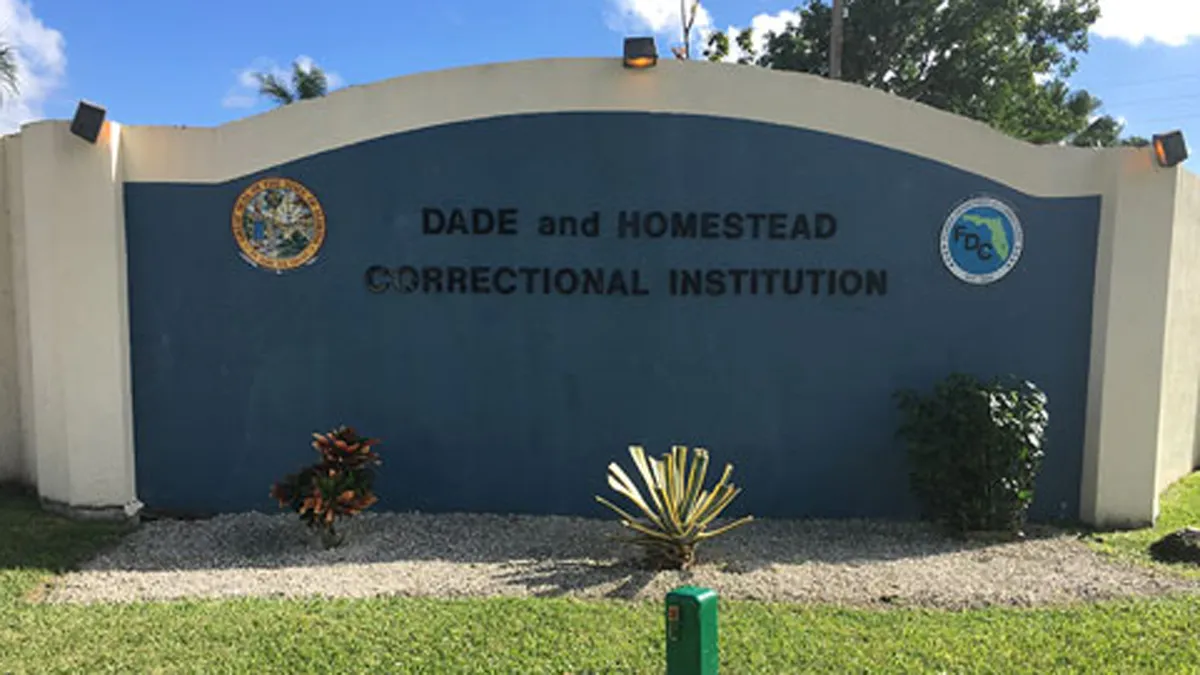

Dade Correctional Institution (DCI) is a Florida Department of Corrections (FDC) prison at 19000 SW 377th Street in Florida City, Miami-Dade County, near the southern tip of the Florida mainland. Opened in 1976, DCI has been the subject of significant public scrutiny over the years, including a widely reported 2012 inmate death and, more recently, an active federal class-action lawsuit over heat conditions. This guide covers who is held at Dade CI, that documented history, and the practical steps for visiting, writing, sending money, and staying in touch with someone incarcerated there.
History of Dade Correctional Institution
Dade CI opened in June 1976 as a minimum-security facility built for 528 inmates at a construction cost of roughly $8.8 million. Over the decades that followed, the institution's mission expanded well beyond minimum security, and it now houses men across minimum, medium, and close custody. DCI sits adjacent to Homestead Correctional Institution, a separate FDC facility for women, in the same general area near Florida City.
The Darren Rainey Case
Any thorough, honest account of Dade Correctional Institution needs to address the death of Darren Rainey, one of the most widely reported incidents involving a Florida prison in recent decades. On June 23, 2012, Rainey, a 50-year-old inmate with schizophrenia serving a sentence for cocaine possession, died after being placed by guards in a shower rigged so he could not control the water temperature; the water was later measured at roughly 160°F. Rainey had reportedly been locked in for about two hours after allegedly smearing feces in his cell, and a responding paramedic documented second- and third-degree burns over more than 30 percent of his body.
The case initially drew little outside scrutiny, but Miami Herald reporter Julie K. Brown obtained public records and began investigating starting in 2014, which prompted renewed police interest. That reporting also surfaced allegations that at least eight other inmates in the same mental-health housing unit — then called the Transitional Care Unit — had been subjected to similar scalding-shower incidents, prompting formal complaints to federal authorities from organizations including Amnesty International, the ACLU of Florida, and the Florida Council of Churches. FDC's Secretary suspended and then fired the facility's then-warden in July 2014 following the investigation.
The U.S. Department of Justice opened its own investigation in May 2015. In January 2016, the Miami-Dade Medical Examiner ruled Rainey's death accidental, attributing it to a combination of the shower confinement and his pre-existing cardiopulmonary disease and schizophrenia; a fuller autopsy report was never made public, and ultimately no criminal charges were filed against any staff member. Rainey's family later settled a civil wrongful-death lawsuit against the state for $4.5 million in 2018. Families researching this facility deserve to know this history plainly and accurately — it is well-documented through public records and extensive news reporting, not rumor, and it remains part of understanding what DCI is and how it changed afterward.
Other Documented Incidents
In July 2014, inmate Lavar Valentin was found dead of strangulation at the facility, with his cellmate accused of the killing. In April 2022, four correctional officers were arrested in connection with the February 2022 beating death of inmate Ronald Ingram during a facility transfer. These are documented, individual incidents from public records and news reporting, presented here as part of an accurate history of the facility rather than a claim about current, day-to-day conditions.
Current Litigation Over Heat Conditions (2024–2025)
Dade CI is currently the subject of active federal litigation that families should be aware of. In October 2024, the Florida Justice Institute filed a federal class-action lawsuit against FDC, the department's secretary, and the facility's warden, alleging unconstitutional conditions related to heat: the complaint alleges that dormitories and dining areas lack adequate air conditioning or ventilation, with heat index readings regularly reaching the National Weather Service's "danger zone" during summer months, and that this disproportionately affects older and medically vulnerable inmates. A federal judge denied the state's motion to dismiss in May 2025, allowing claims under the Eighth Amendment, the Americans with Disabilities Act, and the Rehabilitation Act to proceed. The case was certified as a class action in October 2025, covering current and future DCI inmates. This litigation remains unresolved as of this writing, and families with a loved one at DCI, particularly those with heat-sensitive medical conditions, may want to monitor its progress or raise related concerns directly with the facility's medical staff.
Who Is Held at Dade Correctional Institution
DCI is a male-only facility housing minimum, medium, and close custody inmates, and it maintains an active mental-health treatment unit — the same general type of unit associated with the facility's history above, now operating under close, monitored clinical oversight. A state facility survey conducted in February 2025 documented individualized service plans and multidisciplinary treatment team reviews for inmates receiving mental-health care, with most measured compliance areas scoring in the 88–100% range. Reported capacity figures vary by source: our directory's baseline lists approximately 1,606 beds, while a 2025 state survey put the main unit's rated capacity at roughly 1,406 with a census of 1,335 at the time of that visit — treat exact capacity as approximate and confirm current figures with the facility if precision matters for your situation.
PrisonAssist.com's directory currently holds roughly 18,104 arrest and booking records associated with Dade Correctional Institution. That figure is a historical count of records compiled in our directory over time, not a live population snapshot — the facility's actual current population is governed by its bed capacity and turns over as people are released, transferred, or newly arrive.
Programs and Services
DCI offers anger-management and conflict-resolution courses, parenting classes, financial-planning workshops, stress-management programming, and mental-health counseling, in addition to the specialized clinical mental-health unit described above. The facility's clinical staffing, per the 2025 state survey, includes physicians, registered nurses, a dentist, a psychiatrist, and multiple psychologists, as well as some documented staffing vacancies, consistent with challenges reported across the FDC system generally.
The 2025 survey's individualized service plans and multidisciplinary treatment team reviews for mental-health patients reflect a level of clinical structure that developed specifically in the years following the facility's most scrutinized period, and the reported 88–100% compliance scores across most measured areas suggest that structure is being actively maintained rather than existing only on paper. For a family with a loved one receiving mental-health care at DCI, it's reasonable to ask their treatment team directly about their individualized plan and how often it's reviewed, since that level of documentation is something the facility is already required to maintain.
How to Find an Inmate at Dade Correctional Institution
If you believe a loved one has been transferred to DCI — typically after sentencing and intake processing at a reception center, not immediately after arrest — search their name on PrisonAssist.com to check our records, then confirm current custody status and exact location with FDC's official inmate locator or by calling the facility directly at 305-242-1900.
Visitation at Dade Correctional Institution
Regular visiting runs Saturdays, Sundays, and approved holidays, 9:00 a.m. to 3:00 p.m., with visitor check-in beginning at 8:15 a.m. and processing generally stopping at 2:00 p.m. Visitors aged 12 and older need a pre-approved application, which can take up to 30 days to process, so plan well ahead of any trip. Bring valid government-issued photo identification, and note that visits are typically scheduled by appointment through a request window earlier in the week. Confirm current hours and any facility-specific rules by phone before traveling, since visitation policy can be adjusted at the facility's discretion.
Sending Mail to an Inmate
Florida centralizes routine inmate mail statewide: address letters using the inmate's committed name and DC#, then send them to PO Box 23608, Tampa, FL 33623, rather than to the facility's street address in Florida City. Mail is scanned centrally and delivered electronically to the inmate; legal and privileged mail is handled separately and goes directly to the institution, opened only in the inmate's presence. Mail must go through USPS only, written in English, Spanish, or Haitian Creole, absent prior approval; otherwise, use only metered or plain envelopes, pencil or blue or black ink, with no padded envelopes, boxes, plastic, or metal parts. Our letter-writing service formats, prints, and mails letters and photos so they're built to clear inspection the first time.
Sending Money and Commissary
DCI's deposit system runs through JPay, FDC's official statewide vendor for inmate funds. Deposits can be made online at jpay.com (typically posting the next business day) or by mailing a money order payable to JPay, along with a deposit slip, to JPay, P.O. Box 260010, Hollywood, FL 33026, which generally takes about 10 business days to post. As with other FDC facilities, the sender generally needs to be on the inmate's approved visitor or contact list first.
Phone Calls
Florida's inmate telephone system has shifted between contracted vendors over the years as the statewide contract has been rebid, with both Global Tel*Link (now operating under the ViaPath/ConnectNetwork brand) and Securus Technologies having held pieces of that business at different points. Confirm the currently active vendor and rate directly with the facility before setting up a calling account.
Release and Life After Dade CI
It's worth being direct about something families sometimes ask: bail does not apply once someone is incarcerated at Dade Correctional Institution. Bail is a pretrial tool used to secure release from county jail while a case is still pending. By the time someone is transferred to an FDC state prison like DCI, they have already been convicted and sentenced, so release instead comes from completing the sentence, earning statutory gain time for good behavior and program participation, or, in limited cases involving older pre-1983 offenses, parole eligibility. If bail is still relevant to your family's situation, that generally means the person is still in county jail awaiting trial or sentencing rather than at DCI — our bail bonds service is built for that earlier stage. What families of someone already at DCI can do is stay connected by writing letters, sending photos, shipping an approved care package, keeping commissary funds through JPay, and setting up affordable phone service.
On the gain time question specifically, Florida operates under what's commonly called the "85% law": for most felony offenses committed since 1995, state law requires an inmate to serve at least 85% of their imposed sentence regardless of gain time earned. On that floor, FDC can award basic gain time for inmates who follow institutional rules and, separately, incentive gain time tied to completing education, vocational, or counseling programs like those described above. This isn't discretionary parole; it's time credited against a fixed sentence for documented good behavior and program completion, and it can be reduced or forfeited for serious disciplinary infractions.
Incarceration in Florida: The Bigger Picture
Florida's overall imprisonment rate runs around 371 people per 100,000 residents, with a total state prison population near 81,027 and a county jail population near 56,660 statewide. Dade CI, with its capacity in the range of roughly 1,400–1,600 beds depending on the source, is one of several major South Florida institutions serving that population, and its history — from the Darren Rainey case to today's ongoing heat-conditions litigation — makes it one of the more closely watched single facilities in the state's correctional system.