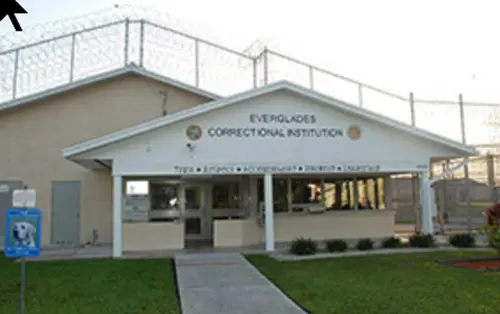

Everglades Correctional Institution (ECI) is a Florida Department of Corrections (FDC) prison at 1599 SW 187th Avenue in Miami, Miami-Dade County, holding more than 1,600 adult men under state custody. Opened in the mid-1990s to add prison capacity in South Florida, ECI became statewide news in the early 2020s as the site of one of Florida's first large-scale "incentivized" prison programs, an approach the department has since looked to expand. This guide covers who is held at Everglades CI, what makes its program model different, and the practical steps for visiting, writing, sending money, and staying in touch with someone incarcerated there.
History of Everglades Correctional Institution
Everglades CI opened in the mid-1990s (commonly cited as 1994 or 1995) as Miami-Dade County's state prison population grew and FDC expanded capacity in South Florida. For its first two and a half decades, it operated as a fairly typical medium-security men's institution.
That changed in January 2019, when FDC launched a first-of-its-kind pilot at ECI: an "incentivized" housing and privilege model in which inmates who go four consecutive years without a disciplinary report qualify for meaningfully improved conditions — better food options, expanded movement within the facility, additional recreation time, and occasional live entertainment. The idea, unusual for a state prison system, was to give inmates a concrete, sustained incentive to avoid violence and rule violations rather than relying purely on punishment for infractions. By mid-2021, after roughly two years of data, ECI was reported to be the safest of Florida's 64 correctional institutions, and the department began planning to extend the model to additional facilities.
In 2022, ECI drew further national attention when gospel artists Maverick City Music and Kirk Franklin recorded portions of the album Kingdom Book One on-site, with roughly 1,300 incarcerated men participating — a project explicitly aimed at spotlighting mass incarceration through music rather than simply staging a performance.
Who Is Held at Everglades Correctional Institution
ECI is a male-only facility. Sources describe its custody mix as spanning minimum, medium, and close custody, and its capacity is reported inconsistently across sources — official figures point to roughly 1,700–1,800 beds in the main unit, with one 2024 population snapshot putting the count slightly above 1,850, including an attached 432-bed re-entry center. Because exact figures shift with FDC's population management, treat any specific number as an approximation and confirm current capacity directly with the facility if precision matters for your situation.
PrisonAssist.com's directory currently holds roughly 20,398 arrest and booking records associated with Everglades Correctional Institution. As with any FDC state prison, that is a historical count of records compiled in our directory over time, not the number of people currently inside — the facility's real-time population is governed by its bed capacity and changes as people are released, transferred, or newly arrive. If you're trying to confirm whether someone is currently at ECI, search their name in our directory and verify with FDC's official inmate locator or the facility itself.
The Everglades Incentivized Program
What sets ECI apart from most Florida prisons is its structured incentive track. Inmates who maintain a clean disciplinary record for four straight years become eligible for a package of improved conditions not available in standard general population housing. The program also layers in career counseling, wellness programming, structured reentry planning, and peer-led classes — including Toastmasters-style public speaking, conflict-resolution training, victim-impact awareness sessions, and meditation. Vocational offerings tied to the broader push toward employability on release have included barbering, water-treatment-plant operator training, and commercial driver's license (CDL) preparation. If a loved one is at ECI, these programs are worth asking about directly, since eligibility and available slots can change based on time served without infractions.
The four-year clean-record threshold is meaningful in practice: it means a single disciplinary report can reset someone's progress toward the improved-conditions track, which gives families a concrete reason to encourage a loved one toward steady, rule-following behavior beyond the general incentive every inmate already has to avoid trouble. If you're corresponding regularly with someone at ECI, asking how their standing looks toward that four-year mark is a natural, supportive way to stay engaged with their day-to-day progress rather than just their release date.
How to Find an Inmate at Everglades Correctional Institution
If you believe a loved one has been transferred to ECI — typically after sentencing and intake processing at a reception center, not immediately after arrest — search their name on PrisonAssist.com to check our records, then confirm current custody status and location with FDC's official inmate locator or by calling the facility at 305-228-2000. You can also reach the warden's office directly by email at evergladesci.wardenoffice@fdc.myflorida.com, and visitation-specific questions can go to VisitappEvergladesCI@fdc.myflorida.com.
Visitation at Everglades Correctional Institution
Visitors need to be pre-approved before their first visit — FDC facilities generally require a visitor application and background check submitted through the inmate's classification officer well in advance, so this isn't something you can arrange same-day. Once approved, plan to arrive with valid government-issued photo identification and expect a security screening at the gate.
Dress code follows FDC's general standard: clothing should not resemble inmate uniform colors (dark green, blue, or brown), men are expected to wear sleeved shirts and long pants, and women's clothing should cover the shoulders and chest without being revealing. Because dress-code enforcement can turn away a visitor who has traveled a long way, it's worth double-checking current specifics with the facility before you go.
Everglades CI also offers JPay Video Connect paid video visitation as a supplement to in-person visits, priced at $2.95 per 15-minute session, with unused time refunded if a call doesn't go through. This can be a useful option for families who can't make the trip to Miami regularly.
ECI sits in far western Miami-Dade County, near the edge of the Everglades and well outside the urban core — if you're coming from anywhere in the Miami metro area, build in extra drive time beyond what a map estimate suggests, since the last stretch of road is rural with limited services. Plan to arrive with enough buffer before the registration cutoff that a wrong turn or traffic delay doesn't cost you the visit entirely, and bring only what you need through security: valid photo ID, any approved money for vending, and nothing on FDC's prohibited-items list, since anything disallowed usually has to be left in your vehicle.
Sending Mail to an Inmate
Florida centralizes routine inmate mail statewide: address letters using the inmate's committed name and DC# and send them to PO Box 23608, Tampa, FL 33623, rather than to the facility's street address. Mail is scanned centrally and distributed electronically to the housing institution. Mail must go through USPS only, and Florida Administrative Code prohibits boxes, padded envelopes, plastic bags, multi-layer or reinforced packaging, metal fasteners, bubble wrap, and packing peanuts — envelopes that don't meet these rules are typically rejected. Our own letter-writing service handles formatting, printing, and mailing letters and photos so they're built to clear inspection on the first try.
Sending Money and Commissary
Everglades CI's deposit system runs through JPay, now operated under the Securus Technologies umbrella, with 60 on-site JPay kiosks for inmates to check balances and communicate. Families can fund an inmate's account online at jpay.com or via the JPay app using a credit or debit card, by mailing a money order payable to "JPay" with the inmate's name and DC# in the memo line, or in person through MoneyGram at participating Walmart, CVS, and 7-Eleven locations. As with other FDC facilities, anyone sending funds generally needs to be on the inmate's approved contact list first, a requirement in place since March 2022, and money orders must include a copy of the sender's valid photo ID or the funds are returned.
Phone Calls
Florida's statewide inmate telephone contract has shifted between vendors over the years — Global Tel*Link (GTL, now operating under the ViaPath/ConnectNetwork brand) took over the contract from Securus in December 2018 for a term running toward the end of 2025 with renewal options. Because contracts can be rebid and JPay's messaging/kiosk services (under the Securus umbrella) remain active at ECI regardless of which company handles voice calls, confirm the current active phone vendor and rate directly with the facility before setting up a calling account.
A Note on Facility Conditions
Like many Florida prisons built without full air conditioning, ECI relies on industrial fans, exhaust systems, and refrigerated water fountains to manage indoor heat rather than universal climate control — reporting in 2025 noted that only about a quarter of Florida's prison housing units statewide have air conditioning. State lawmakers set aside $300,000 in the 2025–26 budget for an air-conditioning pilot program that would have included ECI, but the governor vetoed that funding in June 2025 as part of a larger package of budget cuts. Separately, a March 2025 federal PREA (Prison Rape Elimination Act) compliance audit found ECI's staffing fell below required levels during the audit period, attributing the shortfall to a combination of unscheduled sick leave, FMLA leave, workers' compensation cases, training assignments, and military leave among staff. Families should know that heat and staffing pressure are ongoing, documented realities at many Florida institutions, not unique failures at ECI specifically, and can factor into what day-to-day conditions look like for someone incarcerated there.
Release and Life After Everglades CI
It's worth being direct about something families sometimes ask: bail does not apply once someone is incarcerated at Everglades Correctional Institution. Bail is a pretrial tool used to secure release from county jail while a case is still pending. By the time someone is transferred to an FDC state prison like ECI, they have already been convicted and sentenced, so release instead comes from completing the sentence, earning statutory gain time for good behavior and program participation, or, in limited cases involving older pre-1983 offenses, parole eligibility. If your situation currently involves bail, that generally means the person is still in county jail awaiting trial or sentencing rather than at ECI — our bail bonds service is built for that earlier stage. What families of someone already at ECI can do is stay connected by writing letters, sending photos, shipping an approved care package, keeping the commissary funded through JPay, and setting up affordable phone service.
On the gain time question specifically, Florida operates under what's commonly called the "85% law": for most felony offenses committed since 1995, state law requires an inmate to serve at least 85% of their imposed sentence regardless of gain time earned. Within that floor, FDC can award basic gain time (up to a set number of days per month for inmates who follow institutional rules) and, separately, incentive gain time tied to completing education, vocational, or substance-abuse programs — which is part of why the classes and programs described above aren't just a way to pass time, but can meaningfully affect a release date within the bounds the law allows. None of this is discretionary parole in the traditional sense; it's closer to time credited against a fixed sentence for documented good behavior and program completion, and it can be reduced or forfeited entirely for serious disciplinary infractions.
Incarceration in Florida: The Bigger Picture
Florida's overall imprisonment rate runs around 371 people per 100,000 residents, with a total state prison population near 81,027 and a county jail population near 56,660 statewide. Everglades CI, with a main-unit capacity in the range of 1,700–1,800 beds plus its attached re-entry center, is one of several major South Florida institutions absorbing that population, and its incentivized-program model has made it something of a test case for how the rest of the system might evolve.