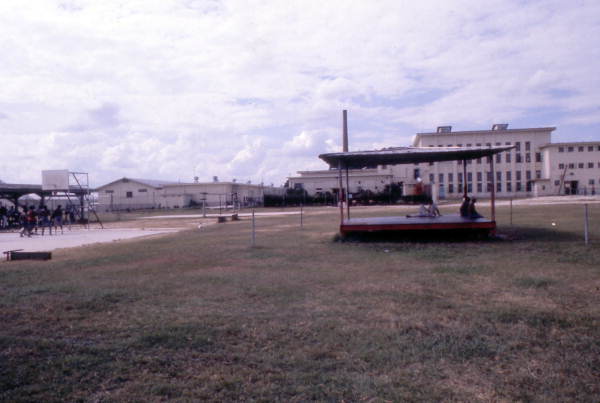

Union Correctional Institution (UCI) is a large, multi-custody-level Florida Department of Corrections (FDC) prison at 25636 NE SR-16 in Raiford, Union County, in the north-central part of the state. It is one of the oldest and largest institutions in the Florida prison system, currently rated for roughly 2,172 adult male beds. Because it sits directly next to a separate, similarly named facility — Florida State Prison — UCI is frequently confused with its neighbor, including in questions about death row and executions. This guide explains who is held at Union CI, how the two Raiford institutions differ, and the practical steps for visiting, writing, sending money, and staying in touch with someone incarcerated there.
A Brief History of Union Correctional Institution
Union CI traces back to 1913, when the state opened the "Florida State Prison Farm" on this site — originally built to house sick and infirm inmates who could not be leased out under Florida's convict-lease system, with an initial population of around 600 men and women. Florida did not fully abolish convict leasing until 1923, making it one of the last states to end the practice, and this Raiford facility became the anchor of the state's prison system once leasing ended.
The prison grew substantially over the following decades. A reform-minded warden, J.S. Blitch, took over in 1919 and pushed early modernization efforts. A license-tag manufacturing plant was added in 1927, tying the facility into what would become Florida's prison industries program. In 1928, the main housing building — known informally as "The Rock" — was constructed; it remained in continuous use until a federal court order forced its closure in 1985 due to conditions. By 1932, the population had passed 2,000. In 1935, the prison added a maximum-security building nicknamed "Flat Top" and a separate West Unit for female inmates; those women were relocated to Florida Correctional Institution in Ocala in 1954. A second maximum-security building, the East Unit, was completed in 1955.
The most important date for understanding today's Raiford complex is July 1972, when the state administratively split the site in two: the East Unit was redesignated as its own institution, Florida State Prison, while the original grounds retained the name Union Correctional Institution. That 1972 split is the direct reason the two prisons are still commonly mixed up more than fifty years later.
Union Correctional Institution vs. Florida State Prison
Because both institutions share a rural Raiford, Florida mailing address and sit on adjoining land, it's worth stating this plainly: Union Correctional Institution and Florida State Prison are two separate, independently operated FDC facilities, each with its own warden, staff, and inmate population, even though they are next to each other near the Union–Bradford county line.
Florida's death row for men is split between the two institutions, and Union CI does house some male inmates under a death sentence. However, the state's only execution chamber is located at Florida State Prison, not at Union CI. When a death warrant is signed by the governor, the condemned individual is transferred to Florida State Prison's death-watch cell in the lead-up to the scheduled execution date; executions themselves are never carried out at Union CI. Female death-row inmates are housed separately, at Lowell Correctional Institution near Ocala. If you're trying to determine where a specific inmate under sentence of death is currently held, search their name directly rather than assuming based on the "Raiford" address alone, since either institution — or Lowell, if the inmate is a woman — is possible.
Who Is Held at Union Correctional Institution
UCI is a male-only institution operating across multiple custody levels simultaneously — its housing units span maximum, close, medium, minimum, and community custody, which is part of why its overall security designation is sometimes listed simply as "State – medium" even though higher-custody units exist on the same grounds. Total rated capacity is approximately 2,172 beds. The facility includes a distinct wing with 156 beds set aside specifically for inmates aged 50 and older, reflecting Florida's broader challenge with an aging prison population as sentences imposed decades ago continue to be served.
PrisonAssist.com's directory currently holds roughly 22,459 arrest and booking records associated with Union Correctional Institution. It's important to understand what that figure does and doesn't mean: it is a historical count of records our directory has compiled over time, not a snapshot of how many people are inside the facility today. The facility's current population is governed by its bed capacity of roughly 2,172 and turns over as inmates are released, transferred, or occasionally pass away in custody. If you're trying to confirm whether someone is currently housed at UCI, the most reliable step is to search their name in our directory and, where possible, verify directly with the facility or FDC's official inmate locator.
Programs and Services
Union CI's Southwest housing unit includes several specialized dormitories aimed at particular populations rather than general population housing alone:
- A faith- and character-based dormitory, offering structured religious and character-development programming for inmates who volunteer for the track.
- A veterans dormitory, connected to an active Vietnam Veterans of America chapter operating inside the institution. That chapter has partnered with the Jacksonville Veterans Treatment Court for more than a decade, mentoring incarcerated veterans and supporting their transition planning.
- A re-entry dormitory for inmates approaching release, focused on the practical and psychological preparation needed to return to the community.
Beyond these specialized units, UCI offers Adult Basic Education and GED preparation for inmates working toward a high school equivalency credential. Vocational and work programming runs through Florida's Prison Rehabilitative Industries and Diversified Enterprises (PRIDE) system, and Union CI's PRIDE work assignments are unusually varied for a single institution — they have historically included a dental prosthetics lab, a meat-processing/slaughterhouse operation, metal fabrication, a license-tag manufacturing plant (a direct descendant of the 1927 tag plant), cattle operations, and forestry work. Chapel services and general religious programming are available to the broader population beyond the dedicated faith-based dorm, and the institution provides mental health services to inmates who need them, consistent with FDC's statewide mental health care obligations.
A separate Union Correctional Institution Work Camp operates nearby at 8000 NW 80th Place, Raiford, FL 32083, phone (904) 368-1500. The work camp houses minimum- and community-custody inmates assigned to PRIDE work details and outside work squads, and is administratively distinct from the main UCI compound even though the two are closely linked.
How to Find an Inmate at Union Correctional Institution
If you believe a loved one has been transferred to Union CI — which typically happens after sentencing and intake processing at a reception center, not immediately after arrest — search their name on PrisonAssist.com to check whether we have a record on file, then confirm current custody status and exact location with FDC's official inmate locator or by calling the facility directly at 386-431-2000. Because state prison populations shift as people are transferred between institutions for programming, medical needs, or security reasons, it's worth rechecking periodically rather than assuming a single record is permanently up to date.
Visitation at Union Correctional Institution
Florida DOC's standard statewide visiting schedule runs Saturdays and Sundays from 9:00 a.m. to 3:00 p.m. Eastern time, with visitor registration opening at 8:15 a.m.; confirm this applies at UCI specifically, and check for any facility-specific adjustments, before you travel, since individual institutions can and do modify the standard schedule.
Dress code is enforced strictly. Visitors should wear full, non-revealing clothing including shoes at all times; only religious head coverings are permitted indoors. Loose-fitting jeans, slacks, or khakis without holes or fraying, collared or loose-fitting sleeved T-shirts, and closed-toe shoes with socks are the safest choices. Clothing that could be mistaken for inmate uniform colors, or that is excessively tight, sheer, or revealing, will typically result in a visitor being turned away at the gate. Bring valid government-issued photo identification and be prepared for a background/security screening, as visitors generally need to be pre-approved before their first visit. Some FDC facilities also offer paid video visitation through JPay's video platform as a supplement to in-person visits; call ahead to confirm whether that option is active at UCI.
Sending Mail to an Inmate
Florida's prison mail system is centralized: rather than mailing letters directly to the facility's street address, routine correspondence for FDC inmates statewide is addressed to the inmate's committed name and DC# and sent to a central processing center at PO Box 23608, Tampa, FL 33623. Mail sent this way is scanned and distributed electronically to the housing institution, which is a significant change from how prison mail worked in years past, so don't rely on an old street-address format you may have seen elsewhere.
Mail must be sent via USPS — other couriers are not accepted — and must be written in English, Spanish, or Haitian Creole unless the inmate has prior warden approval to correspond in another language. Florida Administrative Code prohibits boxes, padded envelopes, plastic bags, multi-layer or reinforced packaging, metal fasteners, bubble wrap, and packing peanuts in inmate mail; envelopes that don't meet these rules are typically rejected and returned. Because getting the format exactly right matters for whether a letter is delivered at all, our letter-writing service formats, prints, and mails letters and photos on your behalf so they're built to clear inspection the first time.
Sending Money and Commissary
Florida DOC's commissary and money-transfer system runs through JPay (part of Securus Technologies). Families can create a free JPay account, search for the inmate by name or DC#, and fund deposits with a credit or debit card; deposits made before roughly 8:00 p.m. Eastern generally post to the inmate's account the next business day. Money orders made payable to "JPay," with the inmate's name and DC# in the memo line, are also accepted and typically process within about ten business days. Cash deposits are additionally available in person through MoneyGram at participating Walmart, CVS, and 7-Eleven locations, up to $1,000 per transaction.
Since March 2022, Florida DOC has required that anyone sending funds be on the inmate's approved visitor/contact list; money orders must include a copy of the sender's valid photo ID, or the funds are returned rather than credited. If you haven't been formally approved as a contact yet, that approval process should be your first step before attempting to send money.
Phone Calls
Inmate phone calls at FDC facilities are handled through a statewide contracted vendor; Florida's contract has historically moved between Securus Technologies and Global Tel*Link (GTL, now operating under the ViaPath/ConnectNetwork brand) as contracts have been rebid, so confirm the current active provider and rates directly with the facility or through FDC before setting up an account, since a phone plan created under the wrong vendor won't work. Whichever vendor is active, calls are generally billed per minute rather than through a flat connection fee, and setting up a prepaid account in advance is the most reliable way to keep the line to your loved one open.
Release, Gain Time, and Life After Union CI
It's worth being clear about something families sometimes ask us: bail does not apply once someone is incarcerated at Union Correctional Institution. Bail is a pretrial mechanism used to secure someone's release from county jail while their case is pending; by the time a person is transferred to an FDC state prison like UCI, they have already been convicted and sentenced, and bail is no longer part of the picture. Release instead comes through completing the imposed sentence, earning statutory "gain time" for good behavior and program participation (which can reduce time served within the limits Florida law allows), or, in the relatively rare cases where it still applies, parole eligibility for older, pre-1983 offenses. If your family's situation currently involves bail, that almost always means the person is still in county jail awaiting trial or sentencing, not yet at a facility like Union CI — our bail bonds service is built for exactly that earlier stage.
What families of someone at Union CI can actively do is stay connected: sending letters and photos, shipping a facility-approved care package, keeping commissary funded through JPay, and setting up affordable phone service, all of which are steps this site can help you arrange.
Incarceration in Florida: The Bigger Picture
Florida's overall imprisonment rate is about 371 people per 100,000 residents, with a total state prison population of roughly 81,027 and a county jail population of roughly 56,660 on any given day. Union Correctional Institution, with its capacity of about 2,172, represents a meaningful share of that system — and its dual role as both a general-population medium-security institution and a facility housing some of Florida's highest-custody and death-sentenced inmates makes it one of the more complex single sites in the state's correctional footprint.